Facial Muscles and Expression Lines: Why Assessment Matters

Updated: 2 days ago
Considering treatment for forehead wrinkles or frown lines? Understanding how your facial muscles, brow position and skin work together is the first step towards choosing the right approach.

You might have noticed deeper lines across your forehead, a crease between your eyebrows that seems to be there even when you're relaxed, or a heaviness around your brows that wasn't there before.
These are among the concerns people seek advice about when considering upper-face aesthetic treatments.
What many people don't realise is that two similar-looking forehead lines can have completely different underlying causes. One might be mainly related to muscle movement, while another involves changes in skin quality or the position of the surrounding tissues.
And that difference matters when choosing a treatment.
At Juvenology Clinic in Maidstone, my approach is to assess the whole upper face, not simply the wrinkle someone wants to improve.
If you're considering treatment for forehead lines, frown lines or changes around your brows, you can book a consultation at Juvenology to discuss your concerns and explore the options available.
Why forehead lines develop
Forehead lines are a natural consequence of facial movement and changes in the skin over time.
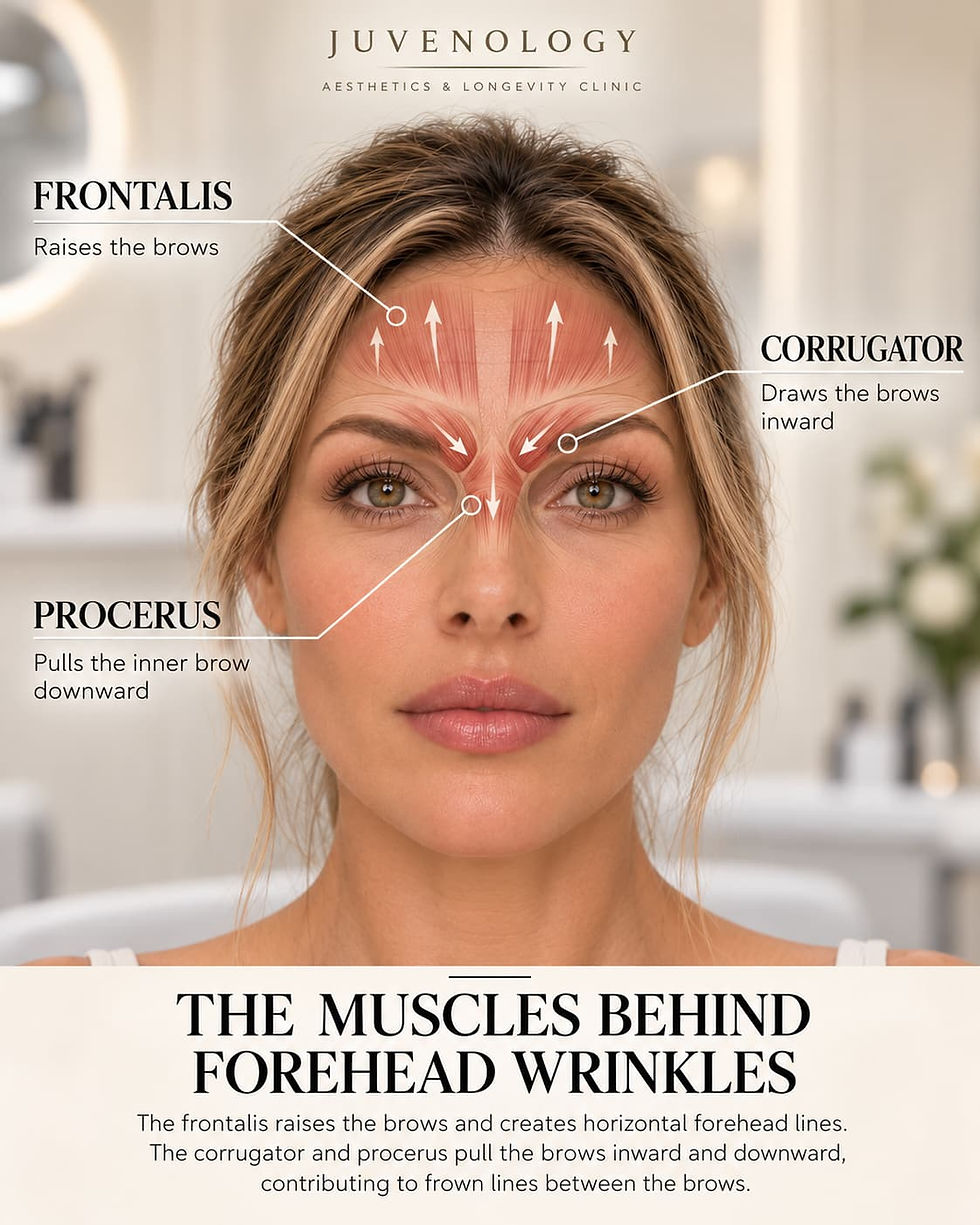
Every time you raise your eyebrows, the frontalis muscle contracts, lifting the brows and creating horizontal folds across the forehead.
When you're younger, these lines may disappear completely once your face relaxes. As the skin changes with age, some lines become increasingly visible even when the muscles are at rest.
There are two important distinctions.
Dynamic wrinkles: lines caused by movement
Dynamic wrinkles appear mainly when you make an expression.
For example, raising your eyebrows creates horizontal forehead lines, while frowning activates muscles between the brows, contributing to the vertical lines sometimes called the '11 lines'.
These movements are completely normal.

However, when the appearance of these lines becomes a concern, wrinkle-relaxing treatments may be an option for suitable patients.
These treatments temporarily reduce activity in selected muscles, which can soften movement-related lines.
The important point is that the treatment needs to account for how those muscles contribute to the position and movement of the brows.
Static wrinkles: lines visible at rest
Static wrinkles remain visible even when your facial muscles are relaxed.
They can develop as the skin gradually loses elasticity and undergoes structural changes associated with ageing, sun exposure and repeated movement.
This distinction matters because reducing muscle movement doesn't necessarily remove an established crease.
Depending on your skin condition and the underlying cause, the discussion may also involve treatments that focus on skin quality.
You can explore these differences further in my guide to forehead lines and their underlying causes.
Why brow position matters before forehead treatment
One of the most important parts of an upper-face assessment is understanding the relationship between the forehead muscles and the brows.

The frontalis muscle is responsible for lifting the eyebrows. Other muscles, including the corrugator and procerus, contribute to pulling parts of the brow downwards.
Together, these muscles influence your natural brow position and facial expressions.
When someone raises their eyebrows, the frontalis contracts. But not everyone uses this muscle in quite the same way.
Some people naturally have lower-set brows. Others recruit their forehead muscles more strongly to help lift the brow area or compensate for heaviness around the upper eyelids.
This becomes particularly important when considering wrinkle-relaxing treatment.
Temporarily reducing forehead muscle activity may improve the appearance of movement-related lines, but it can also affect brow position.
If the frontalis is already helping to maintain brow elevation, reducing its activity may contribute to an unwanted feeling of heaviness.
That's why I consider brow movement and resting position alongside the wrinkles themselves.
The aim isn't simply to soften a line. It's to understand how a proposed treatment could affect the appearance and function of your whole upper face.
What happens during an upper-face consultation at Juvenology?
An upper-face assessment helps establish what's contributing to your concern, which treatment options may be appropriate and what results are realistic.
There are several areas I consider.
1. Your forehead and brows at rest
First, it's important to observe how your upper face looks when you're relaxed.
Are the forehead lines still visible? Do the brows sit at a similar height? Is there any natural asymmetry or heaviness around the upper eyelids?
These observations provide a starting point for understanding your facial anatomy.
2. How your face moves
Next, I look at how the forehead and brow muscles work during natural expressions.
Raising the eyebrows, frowning and narrowing the eyes can reveal differences in muscle activity that aren't obvious in a still photograph.
This helps distinguish lines caused mainly by movement from those involving other changes in the skin and surrounding tissues.
3. Your skin condition
Not every visible line is primarily a muscle concern.
Skin texture, hydration, elasticity and cumulative sun exposure can influence how prominent wrinkles appear.
Understanding the condition of your skin helps determine whether a treatment aimed at muscle movement is likely to address your main concern or whether a different approach deserves
consideration.
4. Previous treatments and medical history
Previous aesthetic procedures can influence the assessment, particularly if you've experienced brow heaviness, asymmetry or an unexpected result.
Your medical history, medicines and any relevant eye or facial symptoms also need to be considered before treatment suitability can be established.
5. What you actually want to achieve
This is just as important as the anatomical assessment.
Some people want to soften a particular frown line. Others are more concerned about forehead wrinkles while keeping their expressions looking natural.
The consultation should establish what matters most to you, discuss the available options and explain the limitations of each approach.
At Juvenology, the objective is to develop an individual plan based on your concerns and suitability rather than assume that everyone needs the same treatment.
Which treatments may help forehead lines and frown lines?
The most suitable approach depends on whether the main concern involves muscle movement, skin condition, structural changes or a combination of these factors.
Wrinkle-relaxing treatments
For suitable patients with expression-related forehead or frown lines, wrinkle-relaxing treatments may help soften the appearance of wrinkles by temporarily reducing selected muscle activity.
These treatments are commonly considered for lines across the forehead and between the eyebrows.
However, the treatment plan needs to account for brow position, natural asymmetry and the relationship between the different upper-face muscles.
A person with strong forehead movement and well-supported brows may have different considerations from someone who relies heavily on their forehead muscles to lift their brows.
You can find out more about wrinkle-relaxing consultations at Juvenology.
Skin-focused treatments
When skin texture or established lines are part of the concern, treatments that focus on skin quality may also be worth discussing.
Juvenology offers skin treatments including microneedling, although suitability depends on the specific concern and skin assessment.
It's important to understand that skin-focused treatments and muscle-relaxing treatments have different purposes. They aren't interchangeable, and results vary.
When treatment isn't the best option
Sometimes the concern relates to the position of the brow, excess upper-eyelid skin or a medical issue that requires assessment outside an aesthetic clinic.
Brow ptosis, where the brow sits lower, and eyelid ptosis, where the upper eyelid droops, are not the same condition.
This distinction is important because the cause determines the appropriate next step.
A new or sudden eyelid droop should receive urgent medical assessment rather than be treated as an ordinary cosmetic concern.
Can upper-face treatment make the brows look heavy or uneven?
Changes in brow position are among the concerns that need to be discussed before wrinkle-relaxing treatment.
The forehead muscles work together to create movement and maintain brow position. Altering the activity of one muscle can change that balance.
For example, reducing frontalis activity may contribute to brow heaviness, particularly when that muscle was helping to elevate the brows before treatment.
Differences between the two sides of the face can also become more noticeable after treatment.
This doesn't mean that everyone who receives upper-face treatment will experience these changes. It means that individual anatomy matters when assessing suitability and discussing risks.
If you've noticed uneven eyebrows after a previous treatment, my article about brow asymmetry after treatment explains why reassessment is important before considering any further procedure.
Why choosing an experienced practitioner matters
Wrinkle-relaxing treatment involves more than deciding where visible lines appear.
A practitioner needs to understand the relevant anatomy, assess muscle movement, recognise when treatment may be unsuitable and explain potential outcomes.
A good consultation should leave you understanding:
What may be contributing to your wrinkles or brow concerns.
Which treatment options are appropriate for consideration.
What improvements may realistically be achievable.
What the treatment cannot correct
What risks, limitations and alternatives you need to consider.
At Juvenology, consultations are led by Marina Kostadinova-Yankova, a registered nurse and the clinic's founder.
My nursing background informs the importance I place on medical history, individual assessment and clear discussions about treatment suitability.
If you're researching aesthetic treatments in Maidstone or the surrounding Kent area, I would encourage you to begin with a consultation rather than choosing a procedure based on a photograph or someone else's results.
What if you're worried about a previous treatment?
If you've experienced an unexpected change in brow position or eyelid appearance after an aesthetic procedure, contact your treating clinician promptly for advice and assessment.
Do not assume that adding more treatment will necessarily correct the problem.
Some changes may require observation, while others need further clinical investigation.
Importantly, sudden eyelid drooping can have causes unrelated to cosmetic procedures, particularly when accompanied by eye pain, double vision, headache or other neurological symptoms. Seek urgent medical assessment.
The MHRA also warns that botulinum toxin products can rarely cause serious effects beyond the injection area. Severe eyelid drooping, difficulty swallowing, slurred speech or breathing difficulty following treatment may indicate a medical emergency. Seek immediate emergency assistance by calling 999.
Frequently asked questions
Can forehead wrinkles be treated without making my eyebrows look heavy?
The risk of brow heaviness depends partly on your existing brow position, muscle activity and the treatment approach. Careful assessment can help identify factors that may increase the risk, although no procedure is completely risk-free.
What is the difference between forehead wrinkles and frown lines?
Forehead wrinkles typically appear horizontally when you raise your eyebrows. Frown lines commonly appear between the eyebrows when muscles involved in frowning contract. Different muscles contribute to these movements, so they require different assessment considerations.
How do I know which wrinkle treatment is right for me?
The most appropriate treatment depends on the type of wrinkles, your skin condition, facial anatomy, medical history and desired outcome. A consultation can help establish whether wrinkle-relaxing or skin-focused treatments may be suitable.
Can I have treatment if one eyebrow is naturally higher?
Natural facial asymmetry is common and doesn't automatically rule out treatment. However, differences in brow height and movement need to be assessed because they may influence treatment planning and the result.
Where can I book a forehead wrinkle consultation in Maidstone?
Juvenology Clinic is based at 82 King Street, Maidstone, Kent ME14 1BH. You can book an appointment to discuss forehead lines, frown lines or upper-face concerns with Marina.
Start with the right assessment at Juvenology Clinic
If you've started noticing deeper forehead lines, persistent frown lines or changes in the position of your brows, the first step is understanding what is contributing to them.
An upper-face consultation gives us the opportunity to look at your facial movement, skin condition and individual anatomy before discussing appropriate treatment options.
You don't need to arrive knowing which procedure you want.
You simply need to tell me what's bothering you and what you'd like to improve.
At Juvenology Clinic in Maidstone, we'll explore the available options together, discuss realistic expectations and decide whether treatment is appropriate for you.
Juvenology Clinic
82 King Street, Maidstone, Kent ME14 1BH
This article provides general educational information and is not a substitute for individual medical advice.
About the author
Marina Kostadinova-YankovaRegistered Nurse | Founder and Clinical Director, Juvenology Clinic
Marina is an NMC-registered nurse and founder of Juvenology Clinic in Maidstone, Kent. Her clinical background includes six years in cardiac nursing at KIMS Hospital and two years as an Aesthetics Nurse Specialist at Spencer Private Hospitals.
She has led Juvenology Clinic for eight years, combining her nursing experience with an individual approach to aesthetic consultations, skin health and treatment planning.
Marina has also completed the Certified Longevity Physician CME Course at the Geneva College of Longevity Science and is a HeartMath Certified Practitioner.
Author biography and credentials subject to Marina's final confirmation.
Last reviewed: October 2026
References
Pessino K, Patel J, Patel BC. Anatomy, Head and Neck; Frontalis Muscle. StatPearls Publishing. Updated 2023. NCBI Bookshelf.
StatPearls. Brow Ptosis. NCBI Bookshelf.
North American Neuro-Ophthalmology Society. Droopy Eyelids (Ptosis). Patient information.
Medicines and Healthcare products Regulatory Agency. Botulinum toxin type A products: updated warnings regarding risk of iatrogenic botulism. 15 July 2026. GOV.UK.