SPECIAL OFFERS

Flexible Payments with PLIM Finance
At Juvenology Clinic, we believe self-care should be accessible. That’s why we’ve partnered with PLIM Finance, a trusted UK provider of interest-free payment plans for aesthetic and wellness treatments.
-
Spread your payments over 3–12 months
-
No interest, no hidden fees
-
Simple, secure application process
Frequently Asked Questions
- 01
PRP stands for Platelet-Rich Plasma. It's autologous therapy, which means we're using your own blood to stimulate hair growth. Nothing synthetic. Nothing foreign. Just your body's natural healing mechanisms concentrated and strategically reintroduced.
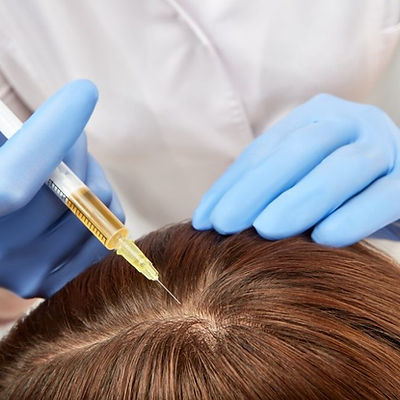
Here's what I love about this treatment from a medical perspective. It's elegant. We draw your blood, spin it in a centrifuge to separate the components, and extract the plasma layer richest in platelets and growth factors. Then we inject that concentrated plasma directly into areas of thinning or hair loss.
Those growth factors, things like platelet-derived growth factor, vascular endothelial growth factor, transforming growth factor, they signal dormant follicles to wake up. They improve blood supply to the scalp. They extend the anagen phase, which is the active growth phase of your hair cycle.
In my cardiac days at KIMS Hospital, I worked with blood components constantly. Understanding plasma, platelets, clotting factors, this was foundational knowledge. That same precision translates beautifully to PRP. I know exactly what I'm looking at when I process your blood. I know what good plasma separation looks like.
- 02
Let me explain the science because it's genuinely fascinating.
Your platelets contain alpha granules packed with growth factors. When we concentrate those platelets through centrifugation, we're creating a solution that's 5 to 10 times richer in growth factors than your baseline blood.
When I inject that PRP into your scalp, several things happen simultaneously. First, the growth factors bind to receptors on hair follicle cells. This triggers cellular proliferation and differentiation. Dormant follicles in the telogen phase, that's the resting phase, can be nudged back into anagen, the growth phase.
Second, PRP stimulates angiogenesis. That's new blood vessel formation. Better vascular supply means better nutrient delivery to follicles. Healthier follicles produce healthier hair.
Third, PRP has anti-inflammatory and anti-apoptotic effects. It reduces scalp inflammation that can contribute to hair loss, and it prevents premature follicle cell death.
Anatomically speaking, we're working with miniaturized follicles in androgenetic alopecia. PRP can't resurrect completely dead follicles, but it can strengthen and revitalize follicles that are struggling. That's the realistic expectation.
- 03
Me. Nurse Marina.
I'm an NMC-registered aesthetics nurse with over a decade of clinical experience, but my background in cardiac nursing is what really sets me apart for PRP. I spent 6 years at KIMS Hospital working with blood products, IV therapies, and sterile techniques where precision wasn't optional. It was life-saving.
PRP requires meticulous sterile protocol. We're drawing blood, processing it, and reinjecting it. Contamination risk exists at every step. My cardiac training means I'm obsessive about aseptic technique. Every step follows evidence-based infection control standards.
I'm also BACN registered, JCCP verified, ACE Group registered, and a Royal College of Nursing member. I follow strict medical protocols for blood handling and injection techniques. This isn't a beauty treatment. It's a medical procedure requiring proper training and anatomical knowledge.
- 04
PRP works best for specific types of hair loss. Let me be honest about this.
You're a good candidate if you have androgenetic alopecia, that's pattern hair loss in men or women. Early to moderate stages respond best. If you're noticing thinning, widening part lines, decreased density, or miniaturization of hair shafts, PRP can help.
You're also a good candidate if you've had a hair transplant and want to support graft survival and overall density. PRP improves the scalp environment for transplanted follicles.
PRP is less effective, and I'll tell you this upfront, if you have advanced baldness with completely smooth, shiny scalp. Those follicles are gone. PRP can't resurrect them. It can only revitalize follicles that still exist but are underperforming.
Other types of hair loss like alopecia areata, which is autoimmune, or telogen effluvium, which is stress-related shedding, sometimes respond to PRP but results are less predictable.
During consultation, I'll assess your scalp, discuss your hair loss pattern, and tell you honestly whether PRP is appropriate or if other treatments would serve you better.
- 05
I'll walk you through the entire process because I want you to know exactly what to expect.
We start with blood draw. I'll take about 20 to 30 milliliters, similar to a routine blood test. If you're comfortable with having blood drawn, this won't bother you.
That blood goes immediately into specialized PRP tubes and into the centrifuge. The centrifuge spins at a specific speed and duration to separate your blood into three layers: red blood cells at the bottom, platelet-poor plasma at the top, and the golden middle layer, platelet-rich plasma. That's what we're after.
I extract the PRP layer carefully. We're talking about precision here. Too much red blood cell contamination dilutes the growth factor concentration. Too much platelet-poor plasma waters it down. I want pure, concentrated PRP.
Then I prepare your scalp. I'll apply topical anaesthetic if you're sensitive to discomfort. Once you're comfortable, I inject the PRP systematically across the treatment area using very fine needles. I'm targeting the follicular level, placing product at the depth where it can actually reach hair bulbs.
The entire process takes 45 minutes to an hour. You can leave immediately afterward. No bandages. No dramatic recovery.
- 06
Hair restoration requires commitment. This isn't a one-and-done treatment.
The standard protocol I follow is 3 to 4 initial sessions spaced 4 to 6 weeks apart. Why? Because hair growth is cyclical. We need to catch follicles at different phases of the growth cycle and provide sustained growth factor stimulation over time.
After that initial series, most patients need maintenance sessions every 6 to 12 months to sustain results. Your hair follicles don't permanently change. The underlying causes of your hair loss, genetics, hormones, aging, they're still present. PRP manages the condition. It doesn't cure it.
I'll be honest with you during consultation about the time and financial commitment. Some patients see significant improvement after 3 sessions. Others need more.
It depends on your age, hair loss severity, genetics, and how well your body responds to growth factor stimulation.
- 07
PRP is not instant gratification. Hair grows slowly.
Most patients notice their first changes around 8 to 12 weeks. You might feel like your hair texture improves. Maybe shedding decreases. These are subtle early signs.
Visible thickening and new growth typically appear around 3 to 6 months. That's when you'll notice density changes, stronger hair shafts, maybe some new baby hairs along the hairline.
Maximum results usually occur around 9 to 12 months. Hair needs time to cycle through growth phases. We're biologically limited by how fast hair grows, which is roughly half an inch per month.
This timeline can be frustrating for patients who want immediate results. I get it. But hair restoration is a marathon, not a sprint. Anyone promising you dramatic results in weeks is overselling.
- 08
Results vary enormously based on your individual biology.
With proper maintenance sessions, most patients sustain improvement for 12 to 18 months or longer. But here's the thing. PRP doesn't stop the biological aging of your follicles. It doesn't eliminate genetic predisposition to hair loss. It doesn't balance your hormones permanently.
What PRP does is optimize the environment for your existing follicles. As long as you maintain that optimization with periodic treatments, you maintain results. Stop treatments, and the progressive nature of androgenetic alopecia resumes.
Think of it like fitness. You can't go to the gym for 3 months, get fit, and stay fit forever without maintenance. Your body needs ongoing stimulus. Same principle with PRP and hair follicles.
- 09
PRP is exceptionally safe when performed correctly. We're using your own blood. There's no risk of allergic reaction or disease transmission because it's autologous.
The risks that do exist are related to injection technique and sterile protocol. Infection is possible if sterile technique isn't followed. Nerve injury is theoretically possible if injections go too deep, though this is extraordinarily rare in scalp treatment. Bruising and temporary discomfort are common but not dangerous.
In my cardiac days, I learned that sterile technique isn't negotiable. When you're working with central lines, cardiac catheters, blood products, contamination can kill patients. I bring that same obsessive attention to sterile protocol for PRP.
I use single-use, CE-certified PRP kits. I follow strict aseptic technique for blood draw and processing. I use proper injection depth and technique to avoid vascular or nerve structures. Safety is non-negotiable.
- 10
Let's talk about what's normal versus what's concerning.
Normal, expected effects include mild scalp tenderness for 24 to 48 hours. You'll feel like you've had multiple injections, because you have. Slight redness or swelling at injection sites. Maybe some pinpoint bruising.
These are tissue responses to injection trauma. They're not complications. They're normal healing processes.
What's not normal? Severe pain, spreading redness, warmth, swelling that worsens after 48 hours. These could indicate infection and require immediate medical attention.
Allergic reactions to PRP itself are virtually impossible because it's your own blood. If you have reactions, it's likely to the topical anaesthetic or cleaning solution, not the PRP.
Most patients tell me the side effects are far milder than they expected. You're sore. You're a bit pink. But you're functional.
- 11
Yes, and I often recommend it for comprehensive results.
PRP pairs beautifully with microneedling. The micro-injuries from needling enhance PRP absorption and trigger additional collagen stimulation. I sometimes perform these together in the same session.
PRP also complements medical hair loss treatments like topical minoxidil or oral finasteride if those are appropriate for you. The mechanisms are different and synergistic. Minoxidil increases blood flow. Finasteride blocks DHT. PRP provides growth factors. Together, they address hair loss from multiple angles.
LED light therapy for scalp stimulation is another option. Some evidence suggests specific wavelengths improve cellular energy production in follicles.
During consultation, I'll assess your hair loss type and recommend a comprehensive treatment plan. Sometimes PRP alone is sufficient. Sometimes a combination approach yields better results.
- 12
Essentially none. You can return to normal activities immediately.
Here's my aftercare protocol. Avoid washing your hair for 24 hours so the PRP has time to penetrate fully without being washed away. Skip vigorous exercise for 24 hours to minimize scalp sweating and irritation. Avoid alcohol for 48 hours because it affects platelet function and healing.
Most patients schedule PRP in the morning and go to work afterward. You might have slight pinkness. Your hair might look a bit unwashed because you can't shampoo immediately. But you're not incapacitated. You're not bandaged. You're functional.
Compare this to surgical hair restoration. FUT or FUE procedures require days of recovery, visible scarring, prolonged healing. PRP is minimally invasive. That's one of its major advantages.
- 13
Standard pricing is £220.
I'll give you transparent pricing during consultation with absolutely no obligation to proceed. I don't believe in pressure tactics or surprise fees.
What I will say: PRP requires medical-grade equipment, sterile single-use kits, comprehensive training, and significant clinical time. You're paying for medical expertise, not a beauty service.
Cheaper PRP often means corners are being cut. Maybe they're using non-medical centrifuges. Maybe sterile technique is compromised. Maybe the practitioner doesn't have proper medical training. Those savings aren't worth the risk.
- 14
You can book directly online or get in touch for more information.
Book: https://www.juvenology-clinic.book.app/book-now Email: office@juvenology.co.uk
Every treatment starts with a full medical consultation. That's where we'll discuss your hair loss history, assess your scalp and follicle health, and create a treatment plan that's realistic and evidence-based.

