Flexible Payments with PLIM Finance
At Juvenology Clinic, we believe self-care should be accessible. That’s why we’ve partnered with PLIM Finance, a trusted UK provider of interest-free payment plans for aesthetic and wellness treatments.
-
Spread your payments over 3–12 months
-
No interest, no hidden fees
-
Simple, secure application process
Frequently Asked Questions
- 01
PDO stands for polydioxanone. It's a biocompatible surgical suture material that surgeons have used safely in cardiac surgery, vascular procedures, and general surgery for decades.
The threads are pre-loaded into fine cannulas, allowing precise placement in specific tissue planes. Over 6 to 8 months, your body gradually absorbs the threads while simultaneously building new collagen scaffolding.
You get immediate mechanical lift plus progressive tissue improvement that lasts beyond the threads themselves.
- 02
Barbed PDO threads have tiny cogs along their length. When I insert these threads following specific facial vectors, the cogs grip surrounding tissue and physically lift sagging structures. You see improvement the moment I'm done. This is pure mechanical elevation, similar to how a suspension bridge works.
Your body recognizes the PDO threads as foreign material, which triggers a controlled healing response. Fibroblasts migrate to the thread sites and begin producing collagen around them. This process continues throughout the 6 to 8 months the threads remain in your tissue. By the time they're fully absorbed, you've built a new collagen framework that maintains structural support.
Anatomically speaking, we're working with the SMAS layer, that's the superficial musculoaponeurotic system, the fibrous tissue beneath your skin that determines facial contour. Proper thread placement in this layer, following natural facial vectors, achieves lift that looks natural because it respects your underlying anatomy.
- 03
I treat multiple facial areas.
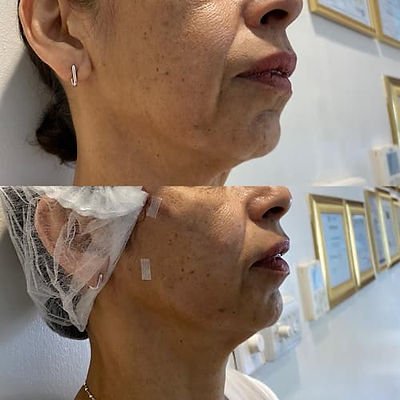
Lower face and jawline: This is where threads excel. Jowls, loss of jaw definition, and marionette lines respond beautifully. I follow the vector from your mandible up toward your temporal region, creating lift that restores that youthful jawline contour.
Mid-face: Threads can address nasolabial folds, cheek hollowing, and mid-face descent. The key is understanding your facial fat compartments and how they've shifted with age.
Brow and forehead: For lifting lateral brows and reducing forehead heaviness. Placement here requires intimate knowledge of the frontal branch of the facial nerve. One wrong placement, and you risk nerve injury.
Neck: Vertical neck bands and skin laxity can improve with properly placed threads, though I'm selective here. Neck anatomy is complex, with vital structures very close to the surface.
Décolletage: Horizontal chest lines respond to smooth mono threads that stimulate collagen without lifting. In clinic, I assess your facial structure before recommending treatment areas. Not everyone needs threads everywhere. Sometimes strategic placement in one or two zones creates the improvement you want.
- 04
PDO itself is exceptionally safe. It's been used in surgery for decades with an excellent safety profile. The material is biocompatible, absorbable, and causes minimal tissue reaction.
The risks come from technique and anatomical knowledge or rather, lack thereof. Your face contains complex vascular and neural networks. The facial nerve branches, the temporal artery, the infraorbital nerve, these structures sit close to common thread placement sites. If your practitioner doesn't know exactly where these vital structures run, complications like nerve injury, vascular damage, or thread malposition can occur.
- 05
PDO threads involve inserting cannulas into tissue layers and manipulating threads beneath your skin. Without anaesthesia, yes, that would be uncomfortable.
That's why we use local anaesthetic. I inject lidocaine along the planned insertion points and thread pathways, just as we'd do for any minor surgical procedure. Once you're numb, most patients describe pressure and pulling sensations rather than pain.
Here's what to expect during treatment. You'll feel the initial anaesthetic injections, tiny pinpricks that sting briefly. Then you'll feel tugging and pressure as I work the threads into position. Some areas are more sensitive than others. Jawline treatments tend to be very tolerable. Brow threads can feel strange because you're aware of movement near your eye area.
The entire procedure takes 45 to 90 minutes depending on how many areas we're treating. Most patients tolerate it well. I work steadily but carefully. This is precision work, not something to be rushed. Post-procedure discomfort is usually mild. Paracetamol manages it. You'll feel tender, tight, and aware of the threads for a few days. That's normal tissue response.
- 06
Completely different mechanisms and indications. Let me clarify because this confusion comes up constantly.
Dermal fillers add volume. They're gel-like hyaluronic acid that sits in tissue planes, filling hollows or augmenting structures like lips, cheeks, or chins. Fillers restore lost volume or create structure where it's lacking. They're reversible with hyaluronidase.
PDO threads lift and tighten. They're surgical sutures that physically elevate descended tissues while stimulating collagen production. They don't add volume. They reposition what you already have and improve tissue quality over time. They're not reversible, they're absorbed gradually.
Think of it this way. If your cheeks have hollowed with age, you need filler to restore volume. If your cheeks have descended and created jowls, you might benefit from threads to lift.
I frequently combine these treatments. Threads provide architectural lift. Fillers restore youthful volume. Together, they achieve comprehensive facial rejuvenation.
- 07
This depends entirely on your facial anatomy, degree of tissue laxity, and treatment goals. For minimal intervention, treating one area like the jawline, I might use 4 to 8 threads. This is for early signs of descent in patients with good tissue quality.
For moderate lifting, addressing jawline, mid-face, or lower face comprehensively, expect 8 to 16 threads or more. This suits patients with noticeable descent but reasonable skin elasticity.
For advanced treatment, combining multiple areas or treating significant laxity, I might use 20+ threads. Older patients or those with poor tissue quality need more threads to achieve and maintain lift.
Here's what I tell patients. More threads don't automatically equal better results. Strategic placement following proper facial vectors matters far more than thread quantity. I've seen practitioners use excessive threads with poor results because they didn't understand anatomy.
During consultation, I assess your tissue quality, descent pattern, and realistic goals. Then I recommend an appropriate thread protocol.
- 08
The threads themselves dissolve over 6 to 8 months. But results typically last 12 to 18 months, sometimes longer. Why? Because the collagen your body produces in response to the threads continues providing structural support after the threads are gone. You've essentially scaffolded new tissue architecture. Longevity depends on several factors:
Your age: Younger patients with better collagen production see longer-lasting results. Your fibroblasts are still relatively active.
Tissue quality: Good skin elasticity and tone maintain lift better. Severely sun-damaged or smoking-damaged skin doesn't hold threads as well.
Lifestyle: Smoking, poor nutrition, and sun exposure accelerate collagen breakdown. Your threads are fighting an uphill battle if your lifestyle undermines tissue health.
Thread type and placement: Barbed threads providing mechanical lift last longer than smooth mono threads meant purely for collagen stimulation. Proper placement in the SMAS layer yields more durable results than superficial placement.
Most of my patients return for maintenance treatments every 12 to 18 months. Some need touch-ups sooner. Others maintain results for two years. Individual biology varies enormously.
- 09
You won't look terrible, but you will look like you've had a procedure.
Immediate post-treatment: Expect swelling, redness, and visible entry points where cannulas were inserted. You might see thread dimpling or puckering as threads settle. Some bruising is common, though I minimize this with careful technique.
First 48 hours: Swelling peaks. Your face feels tight and tender. You're aware of the threads when you smile or move your face. Sleep with your head elevated. Apply ice packs. Take paracetamol.
Days 3 to 7: Swelling starts subsiding. Bruising, if present, begins fading. Thread puckering smooths out as tissues adjust. You can return to work if you're comfortable with residual mild swelling.
Weeks 2 to 4: Most visible signs resolve. Your face settles into its new position. This is when you really start seeing the lifting effect clearly.
Months 1 to 6: Progressive improvement continues as collagen production ramps up. Results actually get better over time, not worse.
Here's my honest advice. Plan your threads when you have a week of downtime if possible. Not because you're incapacitated, but because you'll feel and look puffy initially. Most patients are presentable within 4 to 5 days, but comfort levels vary.
- 10
Poor technique or anatomical ignorance causes most complications.
Thread malposition: Threads placed too superficially create visible ridges or dimpling. Threads placed incorrectly don't achieve lift. Asymmetry results if vector planning was poor.
Nerve injury: The facial nerve branches, particularly the temporal and marginal mandibular branches, sit close to common thread pathways. Accidental nerve trauma causes temporary or permanent facial weakness or numbness.
Vascular complications: The temporal artery, facial artery, and their branches run through treatment zones. Thread placement through a vessel can cause haematoma or, rarely, vascular occlusion.
Infection: Any procedure breaking the skin carries infection risk. Strict aseptic technique minimizes this, but it remains possible.
Thread extrusion or migration: Improperly anchored threads can migrate or extrude through the skin. This requires thread removal.
Skin irregularities: Puckering, dimpling, or visible threads under thin skin.
Here's why I'm so emphatic about proper training. These complications are largely preventable with anatomical knowledge and respect for surgical technique. My cardiac background taught me that cutting corners in medicine has consequences. Thread lifts are no exception.
If you're considering threads, ask your practitioner about their anatomical training, their experience specifically with thread techniques, and how they handle complications. If they can't answer confidently, walk away.
- 11
You're a candidate if:
You have mild to moderate tissue laxity. Threads work best when there's something to lift. Severe sagging needs surgical intervention.
Your skin quality is reasonable. Good elasticity allows threads to create natural-looking lift. Very thin, sun-damaged, or crepey skin doesn't hold threads well.
You want subtle, natural improvement. Threads provide modest lift, not surgical facelift results. Realistic expectations matter enormously.
You can commit to proper aftercare. Threads require careful healing. You need to avoid aggressive facial movements, sleep elevated, and follow post-treatment protocols.
- 12
Absolutely, and I frequently do.
Threads + Dermal Fillers: Threads provide lift. Fillers restore volume. Together, they address both structural descent and volume loss. I usually treat with filler first, allow it to settle, then place threads.
Threads + Botulinum Toxin: Complementary. Botox relaxes dynamic wrinkles caused by muscle movement. Threads lift descended tissue. Combined, they address different aspects of facial aging.
Threads + Skin Boosters (Profhilo, Polynucleotides): Excellent pairing. Threads provide mechanical lift and collagen stimulation. Skin boosters improve tissue quality, hydration, and elasticity. The enhanced tissue quality actually helps maintain thread results longer.
Threads + Microneedling or PRP: These treatments boost collagen production, which synergizes beautifully with thread-induced collagen stimulation. I typically space these treatments appropriately, allowing threads to settle before introducing additional collagen-stimulating procedures.
Timing matters. I don't do everything simultaneously. Your tissues need to respond and heal properly between interventions. Strategic spacing achieves better, safer outcomes.
- 13
This is the most important question you'll ask. Let me give you the criteria that matter.
Medical training: Your practitioner should be a doctor, dentist, or registered nurse with proper anatomical education. Beauticians and non-medically trained individuals should not perform thread lifts. This is surgery, not skincare.
Specific thread training: General aesthetic training isn't sufficient. Ask specifically about thread technique training, how many procedures they've performed, and whether they have mentorship or advanced certification in thread lifts.
Anatomical knowledge: They should be able to explain facial vascular and neural anatomy, SMAS layer function, and facial vectors without hesitation. If they can't discuss anatomy confidently, they don't understand what they're doing beneath your skin.
Complication management: Ask how they handle complications. A practitioner who claims complications never happen is either inexperienced or dishonest. Every aesthetic procedure carries risk. Competent practitioners recognize and manage complications.
Clinical environment: Threads should be performed in a clean, clinical setting with proper sterilization protocols. If the setting looks like a beauty salon, walk away.
Insurance and indemnity: Confirm they have appropriate medical malpractice insurance. This protects you if complications arise.
Before and after portfolio: Review their actual work. Look for natural results, appropriate case selection, and honest documentation. Here's my advice. Interview practitioners. Ask uncomfortable questions. If anything feels rushed, minimized, or glossed over, trust your instinct. Your face deserves someone who respects anatomy as much as I do.
- 14
Post-treatment care directly impacts your results and healing. Here's what matters:
**First 24 hours:**
No makeup or skincare products on treatment areas
Sleep propped up on your back
Apply ice packs to reduce swelling
Take paracetamol for discomfort, avoid ibuprofen
No alcohol
First week:
Continue sleeping elevated
Avoid vigorous exercise or activities
No facial massage, facials, or aggressive skincare
Be gentle when cleansing your face
Avoid extreme facial expressions or movements
No dental work or procedures
Avoid saunas, steam rooms, hot yoga, or anything that heats your tissues
First month:
No facial aesthetic treatments
Avoid extreme weight fluctuations
Protect your skin from sun exposure
These restrictions aren't arbitrary. They allow threads to integrate properly into your tissue without migration or displacement. The first week is critical. I give every patient written aftercare instructions. Follow them precisely.

